> ## Documentation Index
> Fetch the complete documentation index at: https://docs.usefini.com/llms.txt
> Use this file to discover all available pages before exploring further.
# Channel overview
> Fini is headless. Knowledge composes from anywhere, the agent deploys anywhere, and Fini sits as the AI layer between your customers and your human team.
Fini is **headless**. That means three things:
* **Knowledge composes from anywhere**: past tickets, your help center, internal docs in Notion, Confluence, SharePoint, custom APIs, or anything else you can point an integration at.
* **The agent deploys anywhere**: every helpdesk you use, every chat surface your customers touch (website, authenticated app, mobile), your help center, voice, your internal Slack, or your own product over the API.
* **Fini is the first AI layer**: every customer interaction reaches Fini before it reaches a human. The agent resolves what it can; what it can't, it escalates to your team with the full conversation, knowledge sources, and reasoning trace already in their hands.
You don't have to pick one knowledge source and one channel. Most teams compose several of each.
## The architecture
```mermaid theme={null}
---
title: How Fini sits in your stack
---
flowchart LR
subgraph KNOW["KNOWLEDGE SOURCES"]
TICKETS["Past tickets"]
HC["Help center"]
DOCS["Internal docs
Notion · Confluence · SharePoint"]
API_IN["Custom APIs
(your data)"]
end
FINI(("Fini
AI agent layer"))
subgraph DEPLOY["DEPLOYMENT SURFACES"]
HELPDESK["External helpdesks
Zendesk · Intercom · Front · HubSpot
Salesforce · Gorgias · LiveChat
Freshdesk · Deskpro"]
WIDGET["Chat widget
web · authenticated app · mobile"]
INTERNAL["Internal chat
Slack · Discord"]
HELPCENTER["Help center"]
BROWSER["Chrome extension"]
VOICE["Voice"]
API_OUT["API
(anywhere else)"]
end
HUMAN["Your human team
(escalation backstop)"]
TICKETS --> FINI
HC --> FINI
DOCS --> FINI
API_IN --> FINI
FINI --> HELPDESK
FINI --> WIDGET
FINI --> INTERNAL
FINI --> HELPCENTER
FINI --> BROWSER
FINI --> VOICE
FINI --> API_OUT
HELPDESK -.->|"escalate"| HUMAN
WIDGET -.->|"escalate"| HUMAN
INTERNAL -.->|"escalate"| HUMAN
VOICE -.->|"escalate"| HUMAN
classDef source fill:#F7F7F7,color:#131415,stroke:#E8E8E8
classDef agent fill:#131415,color:#FFFFFF,stroke:#131415,stroke-width:3px
classDef surface fill:#FFFFFF,color:#131415,stroke:#131415
classDef human fill:#C3EE5E,color:#131415,stroke:#131415,stroke-width:2px
class TICKETS,HC,DOCS,API_IN source
class FINI agent
class HELPDESK,WIDGET,INTERNAL,HELPCENTER,BROWSER,VOICE,API_OUT surface
class HUMAN human
```
Read the picture left to right. Knowledge flows in from any combination of sources. Fini holds that knowledge, applies your prompts and rules, and answers on whichever deployment surfaces you've connected. When the agent can't resolve a conversation, by policy, by confidence, or because the customer asked for a person, it escalates to your team with the trace and context already attached.
## Knowledge from anywhere
Fini doesn't require you to migrate your knowledge into a new tool. Point it at where your knowledge already lives.
Resolved conversations from your existing helpdesk become training signal, the agent learns the patterns your team has already solved.
Your existing articles index automatically. No copy-paste, no separate CMS.
Notion, Confluence, SharePoint, Google Drive, connect the workspace and the agent reads from it like your team does.
Use [User Attributes](/en/api-reference/attributes) and [Actions](/en/api-reference/actions) to bring in anything else: order status, plan tier, account flags, real-time inventory.
Configure sources under [Knowledge → Sources](/en/knowledge/sources). The full list of integrations and field-level details is documented there.
## Deploy anywhere
Pick the surfaces that match where your customers already reach you. Most teams use more than one.
 ### Facebook
[Facebook](/en/deploy/facebook) connects Pages to Fini for Page comments and Messenger conversations. Authorize the Page, choose its agent, and verify event delivery and replies before rollout. Saved authorization alone does not prove the messaging path is working.
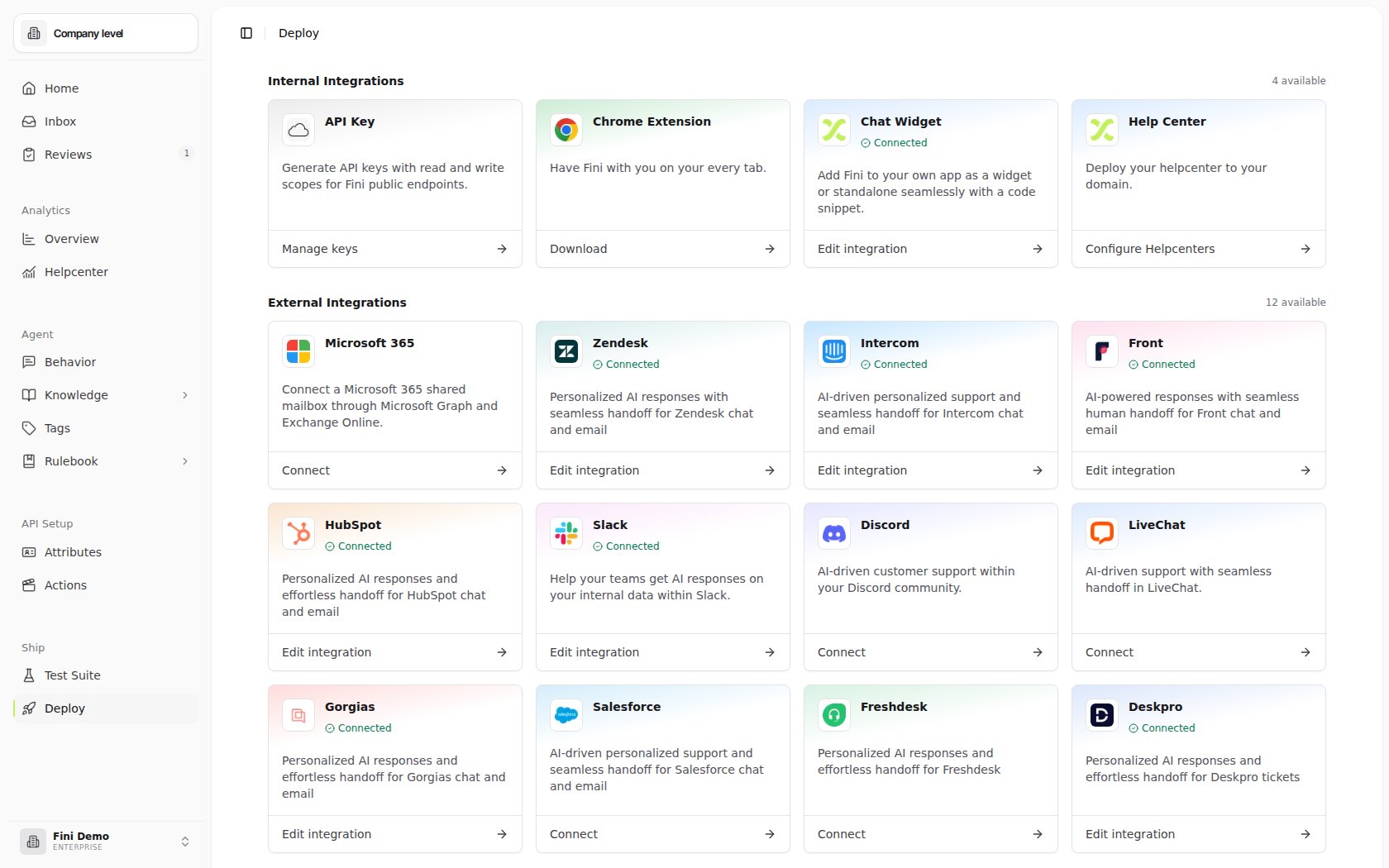
## Internal integrations
Surfaces that Fini ships and you control directly. Configure them once and they're yours — no third-party authorization, no per-channel setup.
Generate workspace-scoped credentials for Fini's public APIs. Keys can carry `read`, `write`, or both, covering agent and interaction reads, conversation events, document ingestion, and knowledge management.
Have Fini with you in every tab. Useful for support agents who want the AI in-context while working on a ticket in any web tool.
Add Fini to your own product as an embedded widget or standalone surface with a single code snippet. Works on web, inside authenticated apps, and in mobile apps (talk to your Fini contact for iOS and Android setup).
Publish a Fini-powered help center hosted on your own domain — your knowledge base, search-enabled, with the AI agent answering search queries directly.
Create support addresses on your domain that route directly into Fini's native Inbox and ticket workspace.
### Chat widget
A chat bubble customers click to talk to your AI agent. The same widget runs in three contexts:
Anonymous visitors and prospects. Drop the snippet into any page.
Logged-in customers, with user identity and metadata passed through. The agent sees who's asking and personalizes accordingly.
Native mobile apps. Same widget, same agent, same configuration. Talk to your Fini contact for the current iOS and Android embedding setup.
See the [Widget](/en/deploy/widget) page for embedding details.
### Help center
A hosted, AI-powered help center, your knowledge base, search-enabled, with the Fini agent answering search queries directly. Set it up in [Help Center](/en/deploy/helpcenter).
### Email
A Fini-hosted email channel for teams that want inbound support addresses on their own domain without routing through a third-party helpdesk first. Add and verify a domain, create one or more bot email addresses, then route each address to the agent that should answer it. Set it up in [Email](/en/deploy/email).
## External integrations
Surfaces that connect Fini to a third-party tool your team already uses. Setup pattern is the same across them: authorize the integration, pick which Fini agent answers on which channel, and configure reply behavior.
Personalized AI responses with seamless handoff for Zendesk chat and email. Supports multiple Zendesk brands.
AI-driven personalized support and seamless handoff for Intercom chat and email across one or many workspaces.
AI-powered responses with seamless human handoff for Front chat and email inboxes.
Personalized AI responses and effortless handoff for HubSpot Inbox chat and email channels.
AI responses from Microsoft 365 shared mailboxes, routed to the Fini agents you choose.
Help your team get AI answers on your internal data within Slack — common for IT, HR, and internal ops support.
AI-driven customer support within your Discord community.
AI-driven support with seamless handoff in LiveChat.
Personalized AI responses and effortless handoff for Gorgias e-commerce support tickets.
AI-driven personalized support and seamless handoff for Salesforce email cases. The most setup-heavy of the helpdesks.
Personalized AI responses and effortless handoff for Freshdesk.
Personalized AI responses and effortless handoff for Deskpro tickets.
### Voice
Fini runs as a voice agent on inbound phone support. Customers reach the same agent through a phone number; calls are transcribed, the agent reasons over your knowledge and rules just like any other surface, and escalates to a human queue when needed. Conversations show up in [Inbox](/en/testing/inbox) alongside chat and email, with the same AI Steps trace available for every turn.
Phone-number provisioning and inbound-call routing still require coordination with your Fini contact. Configuring an agent or starting a browser test does not provision a phone number.
Workspace admins manage voice from **Voice** in the agent sidebar, not from a Deploy integration card. Select the agent, then click **Connect voice** if it is not configured.
Enable the **Voice agent** toggle to edit **Voice**, **Speaking pace**, **Delivery**, **Greeting**, and **Agent prompt**. Use the preview button to hear the selected voice, then click **Save** to apply changes. The page no longer has an **Agent sync** panel or a **Sync now** action.
When browser testing is available and the voice agent is enabled, save any pending changes and click **Start test**. A **Voice test call** dialog opens with a live transcript and call status. Speak into your microphone and follow your messages and the agent's replies in the dialog.
Use **Mute microphone** or **Unmute microphone** during the call. Click **End call** to finish and review the transcript before closing the dialog. Closing the dialog ends an active call and clears the displayed transcript. While connecting, use **Cancel** to stop the attempt.
If testing is unavailable, the page disables **Start test**. Contact your Fini team if setup or testing fails.
To remove the voice connection, click **Disconnect** in the **Disconnect voice** section, then confirm **Disconnect** in the dialog. Fini ends any active browser test and returns the page to the unconfigured state.
Disconnecting removes the voice agent and its voice, greeting, and prompt settings. Reconnecting starts fresh. To pause voice without removing the configuration, turn off **Voice agent** and click **Save** instead.
If the page says **This bot is not available here**, select an agent in your workspace and check that you have an admin role. For **Voice settings unavailable**, click **Retry** or contact your Fini team.
### API
For backend jobs, internal tools, BI exports, conversation-event submission, and knowledge-management workflows, Fini exposes public HTTP APIs authenticated with workspace API keys. The current route map covers agents, interactions, documents, folders, articles, and knowledge-generation jobs. See [API overview](/en/api-reference/overview) and [API Keys](/en/deploy/api-keys) for the full surface and scope model.
## The first-layer pattern
Most production Fini deployments follow the same pattern: **every customer interaction reaches Fini first.** The agent triages, answers what it can, and escalates the rest.
This works because the agent has the same knowledge, the same rules, and the same tools regardless of which surface a customer arrived on. A question about cancellation policy gets the same answer whether it came in by email through Zendesk, through the widget on the website, or through a Slack DM to an internal IT bot. The agent doesn't know or care which surface it's on, it just answers.
What you get from this pattern:
* **One source of truth.** Your knowledge, your prompts, your rules live in one place. Update them once and every channel reflects the change.
* **Consistent answers.** The customer experience doesn't depend on which channel they pick.
* **Triage at scale.** Fini handles the high-volume long tail (password resets, status checks, policy questions, simple how-tos) so your team's time goes to the conversations that actually need a human.
* **Escalations come pre-loaded.** When a conversation does reach a human, the agent's full trace, what was tried, what was retrieved, what the customer's context is, comes with it. Your team starts the conversation already informed.
## Composing surfaces
Surfaces aren't mutually exclusive. Two common composition patterns:
### Run multiple surfaces independently
Each surface handles its own traffic. Common when the audiences are different, for example, the widget on your marketing site serves prospects while the Zendesk integration handles existing customers. The agent's knowledge and configuration can be shared (same bot across surfaces) or split (different bots per surface) depending on how much you want the experiences to diverge.
### Use the widget, escalate into your helpdesk
The most common combined setup. The agent answers in the widget; if it can't help, the conversation hands off as a real ticket in your helpdesk. The customer sees a smooth handoff inside the widget; your support team picks up the conversation in the tool they already use, with the full Fini trace attached.
Today, **Zendesk, Front, Salesforce, HubSpot, and Gorgias** can be widget escalation destinations. The other helpdesk integrations (Intercom, LiveChat, Slack) work as direct integrations only, they don't yet support being the destination for widget escalations.
To set up widget escalation, connect the destination helpdesk first (Zendesk, Front, Salesforce, HubSpot, or Gorgias), then create a [Business Rule](/en/automations/business-rules) for the widget escalation flow. The widget settings page controls embed, styling, identity, and metadata settings; Business Rules own the handoff workflow.
## Where to start
Click into the integration above. Each page walks through the connect flow and configuration.
Start with the Widget. Embed in 5 minutes, configure escalation later.
Start with Help Center. Point at your existing articles, publish.
## Related topics
- [Overview](/en/api-reference/guardrails.md)
- [Behavior](/en/configuration/prompts.md)
This documentation is built and hosted on [Mintlify](https://mintlify.com), a developer documentation platform.
### Facebook
[Facebook](/en/deploy/facebook) connects Pages to Fini for Page comments and Messenger conversations. Authorize the Page, choose its agent, and verify event delivery and replies before rollout. Saved authorization alone does not prove the messaging path is working.
## Internal integrations
Surfaces that Fini ships and you control directly. Configure them once and they're yours — no third-party authorization, no per-channel setup.
Generate workspace-scoped credentials for Fini's public APIs. Keys can carry `read`, `write`, or both, covering agent and interaction reads, conversation events, document ingestion, and knowledge management.
Have Fini with you in every tab. Useful for support agents who want the AI in-context while working on a ticket in any web tool.
Add Fini to your own product as an embedded widget or standalone surface with a single code snippet. Works on web, inside authenticated apps, and in mobile apps (talk to your Fini contact for iOS and Android setup).
Publish a Fini-powered help center hosted on your own domain — your knowledge base, search-enabled, with the AI agent answering search queries directly.
Create support addresses on your domain that route directly into Fini's native Inbox and ticket workspace.
### Chat widget
A chat bubble customers click to talk to your AI agent. The same widget runs in three contexts:
Anonymous visitors and prospects. Drop the snippet into any page.
Logged-in customers, with user identity and metadata passed through. The agent sees who's asking and personalizes accordingly.
Native mobile apps. Same widget, same agent, same configuration. Talk to your Fini contact for the current iOS and Android embedding setup.
See the [Widget](/en/deploy/widget) page for embedding details.
### Help center
A hosted, AI-powered help center, your knowledge base, search-enabled, with the Fini agent answering search queries directly. Set it up in [Help Center](/en/deploy/helpcenter).
### Email
A Fini-hosted email channel for teams that want inbound support addresses on their own domain without routing through a third-party helpdesk first. Add and verify a domain, create one or more bot email addresses, then route each address to the agent that should answer it. Set it up in [Email](/en/deploy/email).
## External integrations
Surfaces that connect Fini to a third-party tool your team already uses. Setup pattern is the same across them: authorize the integration, pick which Fini agent answers on which channel, and configure reply behavior.
Personalized AI responses with seamless handoff for Zendesk chat and email. Supports multiple Zendesk brands.
AI-driven personalized support and seamless handoff for Intercom chat and email across one or many workspaces.
AI-powered responses with seamless human handoff for Front chat and email inboxes.
Personalized AI responses and effortless handoff for HubSpot Inbox chat and email channels.
AI responses from Microsoft 365 shared mailboxes, routed to the Fini agents you choose.
Help your team get AI answers on your internal data within Slack — common for IT, HR, and internal ops support.
AI-driven customer support within your Discord community.
AI-driven support with seamless handoff in LiveChat.
Personalized AI responses and effortless handoff for Gorgias e-commerce support tickets.
AI-driven personalized support and seamless handoff for Salesforce email cases. The most setup-heavy of the helpdesks.
Personalized AI responses and effortless handoff for Freshdesk.
Personalized AI responses and effortless handoff for Deskpro tickets.
### Voice
Fini runs as a voice agent on inbound phone support. Customers reach the same agent through a phone number; calls are transcribed, the agent reasons over your knowledge and rules just like any other surface, and escalates to a human queue when needed. Conversations show up in [Inbox](/en/testing/inbox) alongside chat and email, with the same AI Steps trace available for every turn.
Phone-number provisioning and inbound-call routing still require coordination with your Fini contact. Configuring an agent or starting a browser test does not provision a phone number.
Workspace admins manage voice from **Voice** in the agent sidebar, not from a Deploy integration card. Select the agent, then click **Connect voice** if it is not configured.
Enable the **Voice agent** toggle to edit **Voice**, **Speaking pace**, **Delivery**, **Greeting**, and **Agent prompt**. Use the preview button to hear the selected voice, then click **Save** to apply changes. The page no longer has an **Agent sync** panel or a **Sync now** action.
When browser testing is available and the voice agent is enabled, save any pending changes and click **Start test**. A **Voice test call** dialog opens with a live transcript and call status. Speak into your microphone and follow your messages and the agent's replies in the dialog.
Use **Mute microphone** or **Unmute microphone** during the call. Click **End call** to finish and review the transcript before closing the dialog. Closing the dialog ends an active call and clears the displayed transcript. While connecting, use **Cancel** to stop the attempt.
If testing is unavailable, the page disables **Start test**. Contact your Fini team if setup or testing fails.
To remove the voice connection, click **Disconnect** in the **Disconnect voice** section, then confirm **Disconnect** in the dialog. Fini ends any active browser test and returns the page to the unconfigured state.
Disconnecting removes the voice agent and its voice, greeting, and prompt settings. Reconnecting starts fresh. To pause voice without removing the configuration, turn off **Voice agent** and click **Save** instead.
If the page says **This bot is not available here**, select an agent in your workspace and check that you have an admin role. For **Voice settings unavailable**, click **Retry** or contact your Fini team.
### API
For backend jobs, internal tools, BI exports, conversation-event submission, and knowledge-management workflows, Fini exposes public HTTP APIs authenticated with workspace API keys. The current route map covers agents, interactions, documents, folders, articles, and knowledge-generation jobs. See [API overview](/en/api-reference/overview) and [API Keys](/en/deploy/api-keys) for the full surface and scope model.
## The first-layer pattern
Most production Fini deployments follow the same pattern: **every customer interaction reaches Fini first.** The agent triages, answers what it can, and escalates the rest.
This works because the agent has the same knowledge, the same rules, and the same tools regardless of which surface a customer arrived on. A question about cancellation policy gets the same answer whether it came in by email through Zendesk, through the widget on the website, or through a Slack DM to an internal IT bot. The agent doesn't know or care which surface it's on, it just answers.
What you get from this pattern:
* **One source of truth.** Your knowledge, your prompts, your rules live in one place. Update them once and every channel reflects the change.
* **Consistent answers.** The customer experience doesn't depend on which channel they pick.
* **Triage at scale.** Fini handles the high-volume long tail (password resets, status checks, policy questions, simple how-tos) so your team's time goes to the conversations that actually need a human.
* **Escalations come pre-loaded.** When a conversation does reach a human, the agent's full trace, what was tried, what was retrieved, what the customer's context is, comes with it. Your team starts the conversation already informed.
## Composing surfaces
Surfaces aren't mutually exclusive. Two common composition patterns:
### Run multiple surfaces independently
Each surface handles its own traffic. Common when the audiences are different, for example, the widget on your marketing site serves prospects while the Zendesk integration handles existing customers. The agent's knowledge and configuration can be shared (same bot across surfaces) or split (different bots per surface) depending on how much you want the experiences to diverge.
### Use the widget, escalate into your helpdesk
The most common combined setup. The agent answers in the widget; if it can't help, the conversation hands off as a real ticket in your helpdesk. The customer sees a smooth handoff inside the widget; your support team picks up the conversation in the tool they already use, with the full Fini trace attached.
Today, **Zendesk, Front, Salesforce, HubSpot, and Gorgias** can be widget escalation destinations. The other helpdesk integrations (Intercom, LiveChat, Slack) work as direct integrations only, they don't yet support being the destination for widget escalations.
To set up widget escalation, connect the destination helpdesk first (Zendesk, Front, Salesforce, HubSpot, or Gorgias), then create a [Business Rule](/en/automations/business-rules) for the widget escalation flow. The widget settings page controls embed, styling, identity, and metadata settings; Business Rules own the handoff workflow.
## Where to start
Click into the integration above. Each page walks through the connect flow and configuration.
Start with the Widget. Embed in 5 minutes, configure escalation later.
Start with Help Center. Point at your existing articles, publish.
## Related topics
- [Overview](/en/api-reference/guardrails.md)
- [Behavior](/en/configuration/prompts.md)
This documentation is built and hosted on [Mintlify](https://mintlify.com), a developer documentation platform.