> ## Documentation Index
> Fetch the complete documentation index at: https://docs.usefini.com/llms.txt
> Use this file to discover all available pages before exploring further.
# Articles
> Manage the curated knowledge graph your Fini AI agent retrieves from at runtime: approved articles organized in folders and scoped per agent.
Articles is the **source of truth** for everything your agent knows. [Sources](/en/knowledge/sources), [Magic Articles](/en/knowledge/magic-articles), past conversations, Inbox feedback, manual edits, and background AI proposals all eventually resolve here through the same review / publish workflow. At runtime, this is the layer the agent retrieves from. If a piece of knowledge isn't in Articles, the agent doesn't treat it as authoritative.
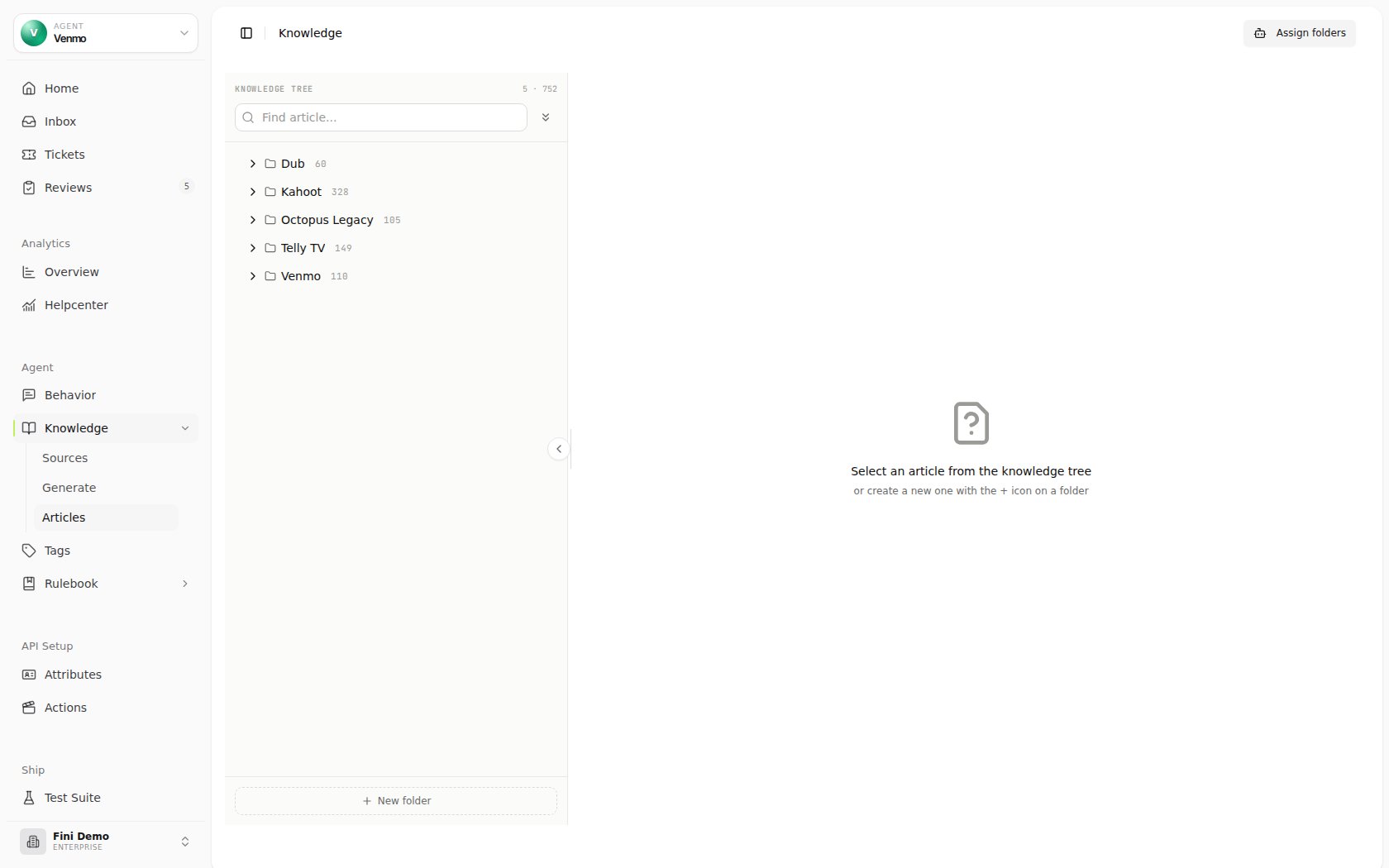 Think of Articles as your **Knowledge Graph**, the curated, deduplicated, conflict-resolved version of everything your team knows. Sources are raw input; Articles is canonical truth. The reason Fini funnels everything through here is so the agent has *one* place to retrieve from, with no ambiguity about which version of a fact wins.
## The folder hierarchy
Articles live inside folders. Folders can contain other folders (subfolders) and articles. The structure is up to you; common patterns:
`Applications & Verification`
`Cards & Issuing`
`Decisioning & Reviews`
`Onboarding / First Setup`
`Day-to-day / Common Issues`
`Cancellation / Refund Policy`
`English / Account`
`Spanish / Cuenta`
`German / Konto`
The system distinguishes three node types internally:
* **Folder (parent)**: contains subfolders and / or articles.
* **Leaf folder**: a folder that contains only articles, no further subfolders.
* **Article**: an individual unit of knowledge.
You don't pick the folder vs leaf-folder type explicitly; Fini infers it from what's inside. Adding a subfolder to a leaf folder promotes it to a parent.
### Search articles and folders
The search field above the tree matches article titles, questions, keywords, Main Knowledge, and Agent Instruction, plus folder names. Search is case-insensitive.
While searching, choose **Tree** to keep matches in their folder hierarchy or **Results** for a flat list of matching articles with their folder paths. Tree view hides unrelated branches and opens paths to matches. A folder-name match keeps its contents available in Tree view; those articles do not appear in Results unless their own content matches.
The counters distinguish matching articles from matching folders. Clear the search to return to the full tree. **Expand all / Collapse all** controls the hierarchy in one click.
## Anatomy of an article
Each article has five authored fields, a few toggles, and attribution metadata. The editor opens in the right pane when you click an article in the tree.
The question or topic phrasing customers would recognize. Drives both human navigation and (lightly) the agent's retrieval. Example: *"Operating address is required" error when updating an application.*
The body of the article, the actual content the agent will reference when composing replies. Use plain prose, lists, blockquotes, or step sequences as fits the topic. Click **Edit** in the top-right of this section to modify.
This is also where you should put any caveats, edge cases, or sub-conditions. The richer the Main Knowledge, the better the agent's answer.
Specific guidance for how the agent should use this article. Distinct from Main Knowledge: this is *meta-instruction* about how to deliver the answer, not the answer itself.
Examples:
* *"Explain that this error is caused by a validation introduced on Oct 15, 2025 for Thread clients. Confirm whether either trigger applies before suggesting a fix."*
* *"Always include the help-center link at the end."*
* *"Don't quote internal pricing."*
Use sparingly. Most articles don't need this field.
Tag-style chips that act as retrieval anchors, terms, error codes, product names, internal jargon. The agent uses these to surface this article when a customer message contains any of them.
Mix exact strings (`operatingAddress`, `BO`, `Thread clients`) with conceptual phrases (`beneficial owner`, `registered agent address`). 6-12 keywords is a healthy range. Click the **×** on any chip to remove it.
A list of paraphrased questions this article answers, each as a full sentence in its own input row. The agent uses these for semantic retrieval, so listing variations meaningfully improves the chance the article matches a real customer query.
Examples for the same article:
* *Can a business application use an international address?*
* *Where do I add `operatingAddress` when updating an application?*
* *Can I use a PO Box as my business address?*
Each question has a trash icon to remove it individually. Aim for 5-10 paraphrasings.
**Pull phrasings from Inbox.** The way customers actually ask is usually different from the way you'd write the question internally. The **View training conversations** button at the top of the editor is the fastest way to see real wording for this article.
A yes/no dropdown. When set to **Yes**, hitting this article triggers an escalation path instead of (or in addition to) serving the answer, useful for topics that should always loop in a human (refund disputes, account closures, security incidents).
### Article-level toggles
On a saved article, two toggles in the status sidebar control whether the article is in play:
* **Active**, when off, the article is excluded from agent retrieval entirely. Use to take an article offline temporarily without deleting it (for example, while you're rewriting it, or during an incident where the answer is in flux).
* **Public in helpcenter**, when on, the article is also exposed via the public help center surface (if you've enabled the [Help Center deploy](/en/deploy/helpcenter)). When off, it's agent-internal only.
Changes to **Active** and **Public in helpcenter** save immediately, separately from content edits. You do not need to save the article again. These toggles do not create a content version or change the last-updated date shown in the public help center. Unsaved content edits stay in the editor.
### Attribution
The side panel shows where an article came from and who last touched it:
* **Created by**: the teammate, API key actor, or system process that created the article.
* **Last updated by**: the teammate, API key actor, or system process that last changed the article.
* **Source**: the article origin, such as **Manual article**, **Created via API**, **Magic article**, **Source import**, **Inbox suggestion**, **Fix review**, **Overnight generation**, or **Fini Scout**.
Use attribution when you need to audit why a fact exists, separate manually authored content from generated content, or review only articles created by a specific workflow.
### Header utilities
Three buttons in the article editor header help you debug and validate an article without leaving the page:
Past conversations Fini used to train or refine this article. Use this to see what real customer wording produced this article in the first place.
The Sources or other inputs this article was derived from. Click through to verify the upstream content is still accurate.
Live conversations where this article was retrieved and served. The fastest way to confirm an article is actually getting used, and to spot cases where it was retrieved but didn't answer the question well.
A **Last updated** timestamp sits below the title so you always know how stale or fresh the canonical version is.
## Assigning knowledge to agents
The agent selector on the Knowledge page is the single most important control on the page. It determines which folders and articles each agent can actually see. When a specific agent is selected, use **Assign folders** to update that agent's folder access.
Defaults to `All`, which shows every folder and article in the workspace regardless of attachment. Picking a specific agent enters agent-specific mode.
The assignment mode shows which folders are available to the selected agent.
Turn on what the agent should see; turn off what it shouldn't. Folder toggles cascade to the articles inside them, unless you explicitly narrow access lower in the tree.
Save to commit the attachment changes for the selected agent.
A worked example for a fintech workspace:
`Applications & Verification`
`Cards & Issuing`
`Decisioning & Reviews`
`Pricing`
`Comparisons`
`Integrations`
`Internal Playbooks`
`Escalation`
`Pricing`
**Don't duplicate to scope.** If two agents need overlapping-but-different knowledge, scope at the folder-attachment layer. Duplicating articles across folders creates exactly the kind of conflict Review exists to prevent.
## Folder configuration
Folders aren't just containers, they carry their own configuration that cascades to every article inside. Right-click a folder (or use its contextual menu) to open **Edit Folder**.
Think of Articles as your **Knowledge Graph**, the curated, deduplicated, conflict-resolved version of everything your team knows. Sources are raw input; Articles is canonical truth. The reason Fini funnels everything through here is so the agent has *one* place to retrieve from, with no ambiguity about which version of a fact wins.
## The folder hierarchy
Articles live inside folders. Folders can contain other folders (subfolders) and articles. The structure is up to you; common patterns:
`Applications & Verification`
`Cards & Issuing`
`Decisioning & Reviews`
`Onboarding / First Setup`
`Day-to-day / Common Issues`
`Cancellation / Refund Policy`
`English / Account`
`Spanish / Cuenta`
`German / Konto`
The system distinguishes three node types internally:
* **Folder (parent)**: contains subfolders and / or articles.
* **Leaf folder**: a folder that contains only articles, no further subfolders.
* **Article**: an individual unit of knowledge.
You don't pick the folder vs leaf-folder type explicitly; Fini infers it from what's inside. Adding a subfolder to a leaf folder promotes it to a parent.
### Search articles and folders
The search field above the tree matches article titles, questions, keywords, Main Knowledge, and Agent Instruction, plus folder names. Search is case-insensitive.
While searching, choose **Tree** to keep matches in their folder hierarchy or **Results** for a flat list of matching articles with their folder paths. Tree view hides unrelated branches and opens paths to matches. A folder-name match keeps its contents available in Tree view; those articles do not appear in Results unless their own content matches.
The counters distinguish matching articles from matching folders. Clear the search to return to the full tree. **Expand all / Collapse all** controls the hierarchy in one click.
## Anatomy of an article
Each article has five authored fields, a few toggles, and attribution metadata. The editor opens in the right pane when you click an article in the tree.
The question or topic phrasing customers would recognize. Drives both human navigation and (lightly) the agent's retrieval. Example: *"Operating address is required" error when updating an application.*
The body of the article, the actual content the agent will reference when composing replies. Use plain prose, lists, blockquotes, or step sequences as fits the topic. Click **Edit** in the top-right of this section to modify.
This is also where you should put any caveats, edge cases, or sub-conditions. The richer the Main Knowledge, the better the agent's answer.
Specific guidance for how the agent should use this article. Distinct from Main Knowledge: this is *meta-instruction* about how to deliver the answer, not the answer itself.
Examples:
* *"Explain that this error is caused by a validation introduced on Oct 15, 2025 for Thread clients. Confirm whether either trigger applies before suggesting a fix."*
* *"Always include the help-center link at the end."*
* *"Don't quote internal pricing."*
Use sparingly. Most articles don't need this field.
Tag-style chips that act as retrieval anchors, terms, error codes, product names, internal jargon. The agent uses these to surface this article when a customer message contains any of them.
Mix exact strings (`operatingAddress`, `BO`, `Thread clients`) with conceptual phrases (`beneficial owner`, `registered agent address`). 6-12 keywords is a healthy range. Click the **×** on any chip to remove it.
A list of paraphrased questions this article answers, each as a full sentence in its own input row. The agent uses these for semantic retrieval, so listing variations meaningfully improves the chance the article matches a real customer query.
Examples for the same article:
* *Can a business application use an international address?*
* *Where do I add `operatingAddress` when updating an application?*
* *Can I use a PO Box as my business address?*
Each question has a trash icon to remove it individually. Aim for 5-10 paraphrasings.
**Pull phrasings from Inbox.** The way customers actually ask is usually different from the way you'd write the question internally. The **View training conversations** button at the top of the editor is the fastest way to see real wording for this article.
A yes/no dropdown. When set to **Yes**, hitting this article triggers an escalation path instead of (or in addition to) serving the answer, useful for topics that should always loop in a human (refund disputes, account closures, security incidents).
### Article-level toggles
On a saved article, two toggles in the status sidebar control whether the article is in play:
* **Active**, when off, the article is excluded from agent retrieval entirely. Use to take an article offline temporarily without deleting it (for example, while you're rewriting it, or during an incident where the answer is in flux).
* **Public in helpcenter**, when on, the article is also exposed via the public help center surface (if you've enabled the [Help Center deploy](/en/deploy/helpcenter)). When off, it's agent-internal only.
Changes to **Active** and **Public in helpcenter** save immediately, separately from content edits. You do not need to save the article again. These toggles do not create a content version or change the last-updated date shown in the public help center. Unsaved content edits stay in the editor.
### Attribution
The side panel shows where an article came from and who last touched it:
* **Created by**: the teammate, API key actor, or system process that created the article.
* **Last updated by**: the teammate, API key actor, or system process that last changed the article.
* **Source**: the article origin, such as **Manual article**, **Created via API**, **Magic article**, **Source import**, **Inbox suggestion**, **Fix review**, **Overnight generation**, or **Fini Scout**.
Use attribution when you need to audit why a fact exists, separate manually authored content from generated content, or review only articles created by a specific workflow.
### Header utilities
Three buttons in the article editor header help you debug and validate an article without leaving the page:
Past conversations Fini used to train or refine this article. Use this to see what real customer wording produced this article in the first place.
The Sources or other inputs this article was derived from. Click through to verify the upstream content is still accurate.
Live conversations where this article was retrieved and served. The fastest way to confirm an article is actually getting used, and to spot cases where it was retrieved but didn't answer the question well.
A **Last updated** timestamp sits below the title so you always know how stale or fresh the canonical version is.
## Assigning knowledge to agents
The agent selector on the Knowledge page is the single most important control on the page. It determines which folders and articles each agent can actually see. When a specific agent is selected, use **Assign folders** to update that agent's folder access.
Defaults to `All`, which shows every folder and article in the workspace regardless of attachment. Picking a specific agent enters agent-specific mode.
The assignment mode shows which folders are available to the selected agent.
Turn on what the agent should see; turn off what it shouldn't. Folder toggles cascade to the articles inside them, unless you explicitly narrow access lower in the tree.
Save to commit the attachment changes for the selected agent.
A worked example for a fintech workspace:
`Applications & Verification`
`Cards & Issuing`
`Decisioning & Reviews`
`Pricing`
`Comparisons`
`Integrations`
`Internal Playbooks`
`Escalation`
`Pricing`
**Don't duplicate to scope.** If two agents need overlapping-but-different knowledge, scope at the folder-attachment layer. Duplicating articles across folders creates exactly the kind of conflict Review exists to prevent.
## Folder configuration
Folders aren't just containers, they carry their own configuration that cascades to every article inside. Right-click a folder (or use its contextual menu) to open **Edit Folder**.
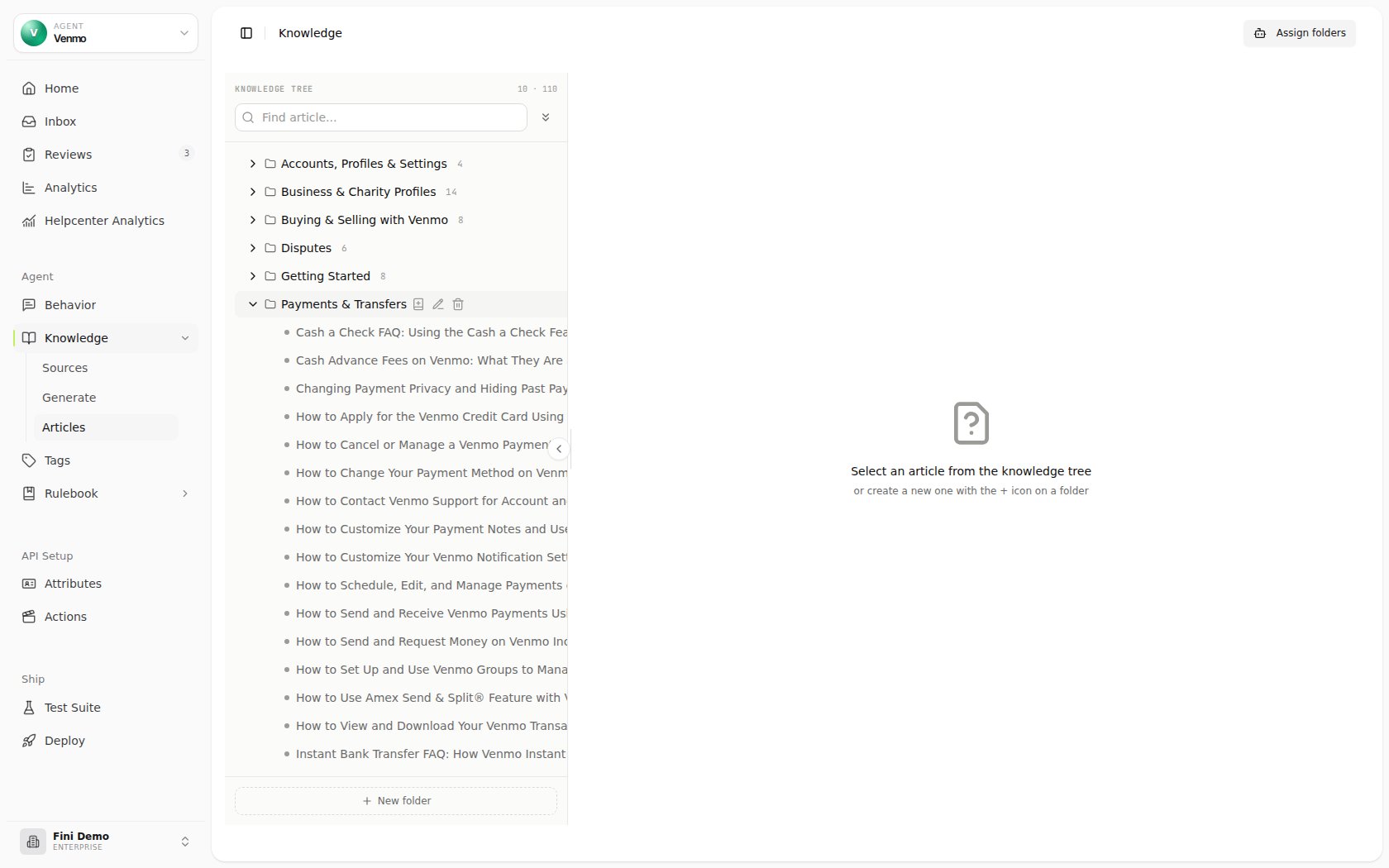 The folder editor surfaces:
* **Title**: the folder's display name.
* **Description**: a one-liner describing what's inside. Helps humans navigating the tree; the agent doesn't retrieve from this.
* **Icon**: the visual icon used for this folder on the public [Help Center](/en/deploy/helpcenter), when the folder is public.
* **Select Bot for Attribute Filters**: which agent the attribute filters below apply to (filters can be configured per agent).
* **Attribute Filters**: conditional rules that gate retrieval (see below).
* **Active**: when off, every article in this folder is excluded from agent retrieval. Use this to take a whole topic area offline (for example, sunset a deprecated product line in one click rather than toggling every article).
* **Public in helpcenter**: same as the article-level toggle, but for the entire folder.
### Attribute filters
Each folder can carry an **Attribute Filter Builder** that gates retrieval on conversation context. Same agent, different rules depending on who's talking.
Examples:
* *"Only retrieve from `Refund Exceptions / *` when `User Attributes → tenure > 12 months`."*
* *"Only show `Enterprise Setup / *` when `User Attributes → plan = Enterprise`."*
* *"Only retrieve from `California-Specific Compliance / *` when `User Attributes → state = California`."*
* *"Only surface `Spanish / *` when `System Attribute → conversation language = Spanish`."*
Click **+ Add Filter** to define a predicate. With no filters, the folder is available to all end-users.
Filters compose with a simple rule:
**Multiple filters with the same attribute = OR · Different attributes = AND.**
For example, two filters on `state` (California *or* Texas) combine as OR. A filter on `state = California` plus a filter on `plan = Enterprise` combine as AND, both must match.
**A filter on a missing attribute silently excludes.** A filter like `plan = Enterprise` excludes every conversation where the `plan` attribute *isn't set at all*, not just non-Enterprise ones. If your agent suddenly stops answering for a segment of users, check whether their attributes are actually being populated.
Filters live on **folders**, not individual articles, if you find yourself wanting a per-article filter, that's usually a sign the article belongs in its own folder.
## Creating folders and articles
Click **+ New folder** at the bottom of the knowledge tree, or use a folder's contextual action to add beneath an existing folder. Provide a name and an optional description.
Hover the folder and click the **+** action. The editor opens with empty Title / Main Knowledge / Agent Instruction / Keywords / Questions fields.
Fill in Title and Main Knowledge first; those are the substance. Add Keywords next (6-12 tags). Then Questions (5-10 paraphrasings). Use Agent Instruction only if you have a specific reason. Decide whether Escalation should be Yes or No.
If the article applies only to certain customer attributes, configure the parent folder's Attribute Filter rather than the article itself. Confirm the folder's Active and Public toggles are set the way you want.
Saving sends the article to [Review](/en/knowledge/review) if your workspace has review-and-approval enabled, or directly to live if not.
**Most articles don't get authored here from scratch.** The fastest path is to ingest content into [Sources](/en/knowledge/sources), run [Magic Articles](/en/knowledge/magic-articles) to generate drafts, approve them in Review, and only then come to Articles to organize the result. Manual authoring is for one-off canonical answers you want to write by hand.
## Editing existing articles
Click an article from the tree to open the editor. Every field is editable in place, click **Edit** in the Main Knowledge header to modify the body, click into any Keyword/Question row to change it, or click the **×** / trash icons to remove individual items.
The **Last updated** timestamp at the top tells you when the canonical version was last saved. Content edits go through the same Review path as new articles when review-and-approval is enabled. The article-level visibility toggles save separately, as described above. Restoring an earlier content version keeps the current **Active** and **Public in helpcenter** settings; it does not re-enable or republish an article you have taken offline.
## Bulk operations
The tree supports a few bulk operations from the page header:
* **Expand all / Collapse all** the tree.
* **Translate**: take selected articles and translate them into another language (creating new articles in a target folder).
* **Trending**: surface the articles getting the most retrieval hits, useful for prioritizing what to keep current.
## Deletion
The **Delete Article** button sits at the bottom-right of the editor. Deleting an article is per-article; to delete a whole folder (and every subfolder and article inside it), use the contextual menu on the folder itself.
Deletion is **irreversible** for live data. Articles attached to agents lose the attachment when deleted. If a deleted article was the only canonical answer for a particular customer question, the agent's reply quality on that topic will degrade until you replace it, either by re-promoting the underlying Source via Magic Articles, or by authoring a new article from scratch.
## Why an article isn't being used
Switch the top-right selector to that agent, confirm the parent folder is toggled on, save. This is by far the most common cause.
Check the **Active** toggle on the article and on every ancestor folder. An inactive folder excludes everything inside it.
Open the folder's **Attribute Filter Builder** in Edit Folder. The predicate may be more restrictive than you expect, especially if it requires an attribute that isn't being populated on the conversation. Remember: same-attribute filters OR together, different-attribute filters AND together.
Open **View usage in conversations** to see what real customer messages look like. If they use a term that isn't in Keywords (an error code, a product nickname, an alias), add it.
Open **View training conversations** or jump to Inbox, find a real customer message that should have hit this article but didn't, and add that phrasing to the Questions list. Retrieval leans heavily on this field.
If two articles both match a query, the more specific one usually wins. Check whether a narrower article is intercepting the query, and if so, decide whether that's correct or whether the two should be merged via [Review](/en/knowledge/review).
Drafts don't serve customers. Open [Review Queue](/en/knowledge/review) and confirm the article has been approved.
## Related topics
- [Magic Articles](/en/knowledge/magic-articles.md)
- [Create article](/en/api-reference/create-article.md)
- [List articles](/en/api-reference/list-articles.md)
This documentation is built and hosted on [Mintlify](https://mintlify.com), a developer documentation platform.
The folder editor surfaces:
* **Title**: the folder's display name.
* **Description**: a one-liner describing what's inside. Helps humans navigating the tree; the agent doesn't retrieve from this.
* **Icon**: the visual icon used for this folder on the public [Help Center](/en/deploy/helpcenter), when the folder is public.
* **Select Bot for Attribute Filters**: which agent the attribute filters below apply to (filters can be configured per agent).
* **Attribute Filters**: conditional rules that gate retrieval (see below).
* **Active**: when off, every article in this folder is excluded from agent retrieval. Use this to take a whole topic area offline (for example, sunset a deprecated product line in one click rather than toggling every article).
* **Public in helpcenter**: same as the article-level toggle, but for the entire folder.
### Attribute filters
Each folder can carry an **Attribute Filter Builder** that gates retrieval on conversation context. Same agent, different rules depending on who's talking.
Examples:
* *"Only retrieve from `Refund Exceptions / *` when `User Attributes → tenure > 12 months`."*
* *"Only show `Enterprise Setup / *` when `User Attributes → plan = Enterprise`."*
* *"Only retrieve from `California-Specific Compliance / *` when `User Attributes → state = California`."*
* *"Only surface `Spanish / *` when `System Attribute → conversation language = Spanish`."*
Click **+ Add Filter** to define a predicate. With no filters, the folder is available to all end-users.
Filters compose with a simple rule:
**Multiple filters with the same attribute = OR · Different attributes = AND.**
For example, two filters on `state` (California *or* Texas) combine as OR. A filter on `state = California` plus a filter on `plan = Enterprise` combine as AND, both must match.
**A filter on a missing attribute silently excludes.** A filter like `plan = Enterprise` excludes every conversation where the `plan` attribute *isn't set at all*, not just non-Enterprise ones. If your agent suddenly stops answering for a segment of users, check whether their attributes are actually being populated.
Filters live on **folders**, not individual articles, if you find yourself wanting a per-article filter, that's usually a sign the article belongs in its own folder.
## Creating folders and articles
Click **+ New folder** at the bottom of the knowledge tree, or use a folder's contextual action to add beneath an existing folder. Provide a name and an optional description.
Hover the folder and click the **+** action. The editor opens with empty Title / Main Knowledge / Agent Instruction / Keywords / Questions fields.
Fill in Title and Main Knowledge first; those are the substance. Add Keywords next (6-12 tags). Then Questions (5-10 paraphrasings). Use Agent Instruction only if you have a specific reason. Decide whether Escalation should be Yes or No.
If the article applies only to certain customer attributes, configure the parent folder's Attribute Filter rather than the article itself. Confirm the folder's Active and Public toggles are set the way you want.
Saving sends the article to [Review](/en/knowledge/review) if your workspace has review-and-approval enabled, or directly to live if not.
**Most articles don't get authored here from scratch.** The fastest path is to ingest content into [Sources](/en/knowledge/sources), run [Magic Articles](/en/knowledge/magic-articles) to generate drafts, approve them in Review, and only then come to Articles to organize the result. Manual authoring is for one-off canonical answers you want to write by hand.
## Editing existing articles
Click an article from the tree to open the editor. Every field is editable in place, click **Edit** in the Main Knowledge header to modify the body, click into any Keyword/Question row to change it, or click the **×** / trash icons to remove individual items.
The **Last updated** timestamp at the top tells you when the canonical version was last saved. Content edits go through the same Review path as new articles when review-and-approval is enabled. The article-level visibility toggles save separately, as described above. Restoring an earlier content version keeps the current **Active** and **Public in helpcenter** settings; it does not re-enable or republish an article you have taken offline.
## Bulk operations
The tree supports a few bulk operations from the page header:
* **Expand all / Collapse all** the tree.
* **Translate**: take selected articles and translate them into another language (creating new articles in a target folder).
* **Trending**: surface the articles getting the most retrieval hits, useful for prioritizing what to keep current.
## Deletion
The **Delete Article** button sits at the bottom-right of the editor. Deleting an article is per-article; to delete a whole folder (and every subfolder and article inside it), use the contextual menu on the folder itself.
Deletion is **irreversible** for live data. Articles attached to agents lose the attachment when deleted. If a deleted article was the only canonical answer for a particular customer question, the agent's reply quality on that topic will degrade until you replace it, either by re-promoting the underlying Source via Magic Articles, or by authoring a new article from scratch.
## Why an article isn't being used
Switch the top-right selector to that agent, confirm the parent folder is toggled on, save. This is by far the most common cause.
Check the **Active** toggle on the article and on every ancestor folder. An inactive folder excludes everything inside it.
Open the folder's **Attribute Filter Builder** in Edit Folder. The predicate may be more restrictive than you expect, especially if it requires an attribute that isn't being populated on the conversation. Remember: same-attribute filters OR together, different-attribute filters AND together.
Open **View usage in conversations** to see what real customer messages look like. If they use a term that isn't in Keywords (an error code, a product nickname, an alias), add it.
Open **View training conversations** or jump to Inbox, find a real customer message that should have hit this article but didn't, and add that phrasing to the Questions list. Retrieval leans heavily on this field.
If two articles both match a query, the more specific one usually wins. Check whether a narrower article is intercepting the query, and if so, decide whether that's correct or whether the two should be merged via [Review](/en/knowledge/review).
Drafts don't serve customers. Open [Review Queue](/en/knowledge/review) and confirm the article has been approved.
## Related topics
- [Magic Articles](/en/knowledge/magic-articles.md)
- [Create article](/en/api-reference/create-article.md)
- [List articles](/en/api-reference/list-articles.md)
This documentation is built and hosted on [Mintlify](https://mintlify.com), a developer documentation platform.