The help center is a deployment surface for Articles, your one source of truth. Every folder and article you mark Public in helpcenter appears on the public site automatically, and everything else stays internal. Fini’s AI Knowledge Manager keeps the content current by detecting gaps and conflicts from every conversation and drafting updates into Review, so the help center improves as your support runs.
What your customers see
Three surfaces make up the public experience: the landing page, the article pages, and, if you attach one, the embedded chat widget.The landing page
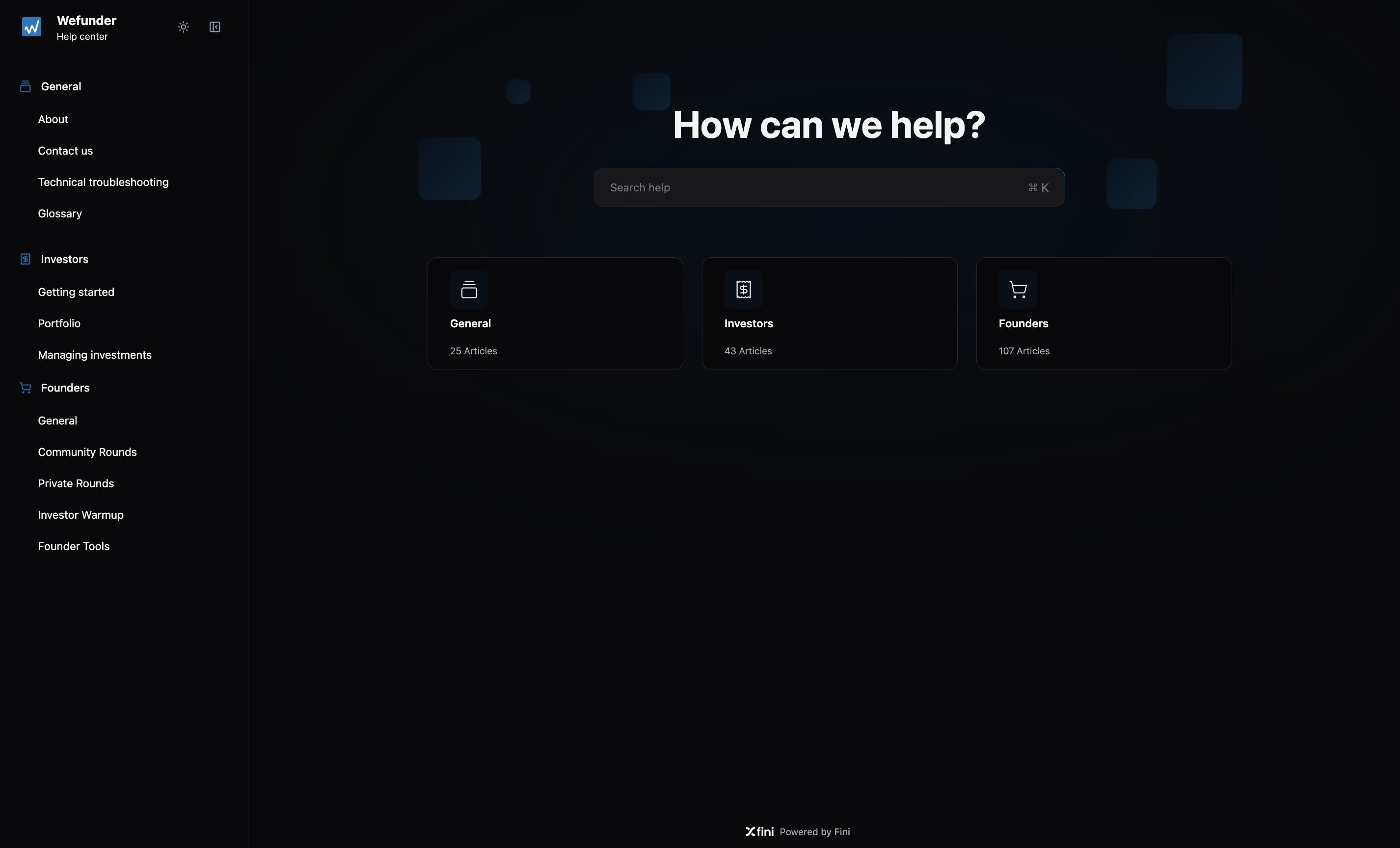
The landing page is built from your published Articles tree. The top-level folders you publish become the category cards, each with its article count, and the nested folder tree becomes the left-hand navigation. The structure you build in Articles is the structure customers see. Two curation controls shape the page beyond the raw tree: featured articles are pinned near the top, and popular folders are highlighted as shortcuts. Both are set from Articles, see Curate the landing page. An AI-powered search bar sits front and center, with a⌘K or Ctrl K keyboard shortcut. Customers type a question in natural language and get a list of matching articles, which handles the long tail of self-serve questions that don’t need a human or customer-specific context.
The site ships with a glass-styled design, a persistent Topics panel, a floating pill navigation with Search and Contact us, translucent cards over a soft dark or light background, and a theme toggle so customers can switch themes on their own. The public page uses the appearance settings saved on the help center card: color, accent color, hero title, logo, and font.
Article pages
Each article opens with a breadcrumb trail back through its folder path, an estimated read time, and the date it was last updated. A search box stays in the top-right, so customers can search again without returning to the landing page. On the right side, an On this page table of contents lists the article’s headings and subheadings. Customers use it to jump between sections without losing their place in a long article. At the bottom, customers can answer Was this article helpful? with a thumbs-up or thumbs-down. Fini stores the visitor’s choice locally so the same browser doesn’t vote repeatedly on the same article, and records the vote so you can see which content is helping, see Measure and improve.The embedded widget
If you attach a widget, a chat bubble loads on every help center page. The widget and the help center share the same agent, the same knowledge graph, and the same business rules; the widget adds customer context on top, identity, account data, and conversation history, so it can answer customer-specific questions and escalate to a human through your connected helpdesk when it can’t resolve something. The two surfaces split the load deliberately: docs answer the what, the widget answers the what about me. Customers browse and search first, and open the widget for anything personal to their account. If you leave the widget unset, the help center is article-and-search only.Where the content comes from
The help center publishes the selected agent’s public snapshot, the subset of your knowledge graph that meets two conditions:- The article is attached to the selected agent.
- The article is marked Public in helpcenter.
Set up your help center
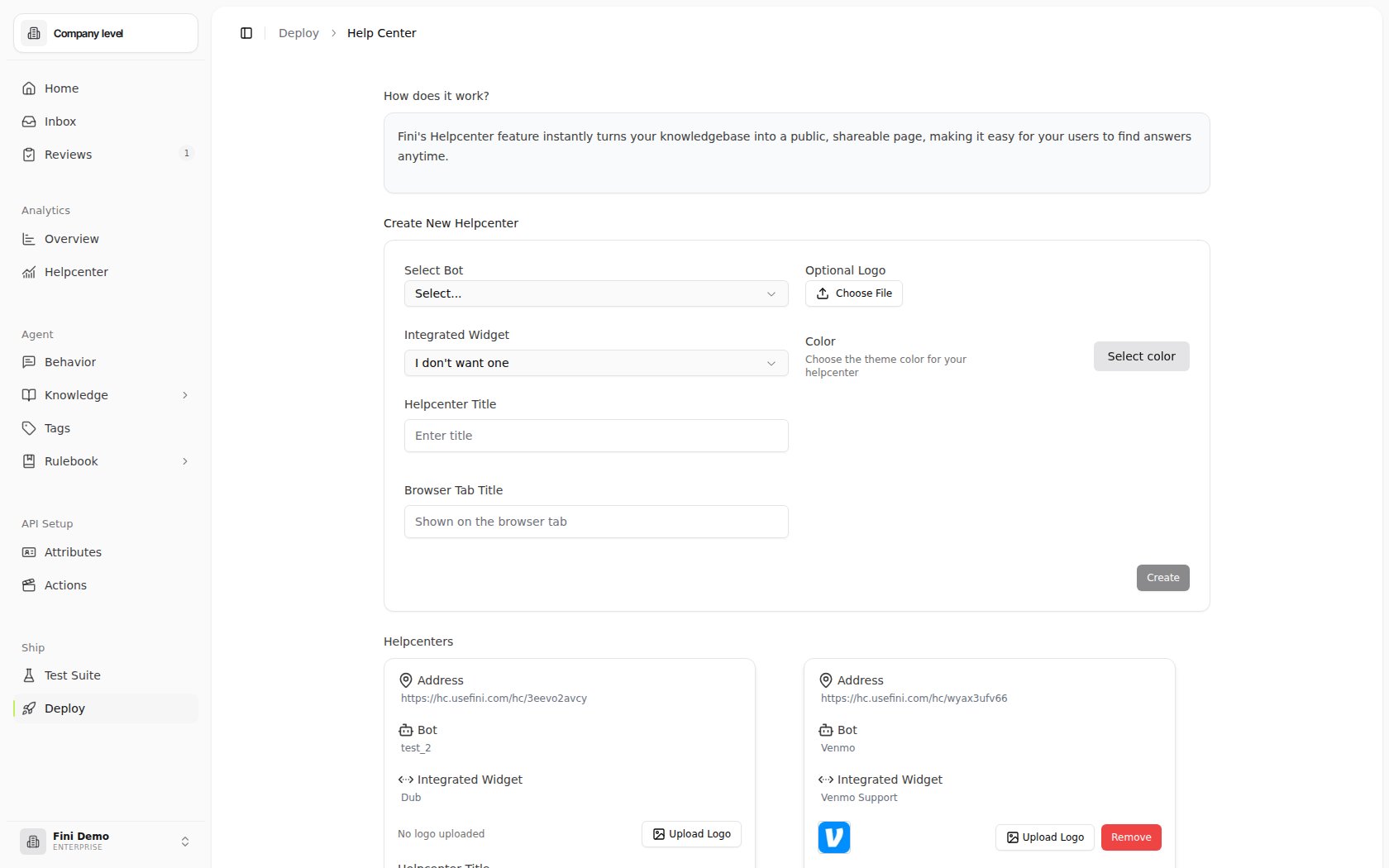
Setup is self-serve from Deploy → Help Center. The top of the page is the creation form; existing deployments are listed below it.Before you start
You’ll need:- At least one agent in Fini. The help center is tied to one agent, and that agent’s attached articles are what gets published.
- The folders and articles you want exposed marked Public in helpcenter in Articles.
- (Optional) An existing widget to embed inside the help center.
- (Optional) A logo, page title, browser tab title, and brand color.
Each agent can have one help center deployment. If you’ve already created a help center for an agent, you can’t create a second one for the same agent, edit or delete the existing one instead.
Create the help center
1
Select the agent
Pick the Fini agent whose public knowledge should power the help center. This choice is fixed after creation. To switch agents later, delete the help center and create a new one.
2
(Optional) Attach an integrated widget
The Integrated Widget dropdown attaches an existing widget deployment to the help center. Leave it set to I don’t want one for a docs-and-search-only experience. This choice is also fixed after creation.
3
Set the branding
Fill in Helpcenter Title (the heading on the page), Browser Tab Title (what shows in the browser tab), optionally upload a logo, and pick a theme color. Branding stays editable after creation.
4
Click Create
Fini provisions the public help center and generates its hosted address.
https://hc.usefini.com/hc/<generated-slug> and isn’t editable. For a branded subdomain such as help.yourcompany.com, see Use a custom domain.
Manage existing help centers
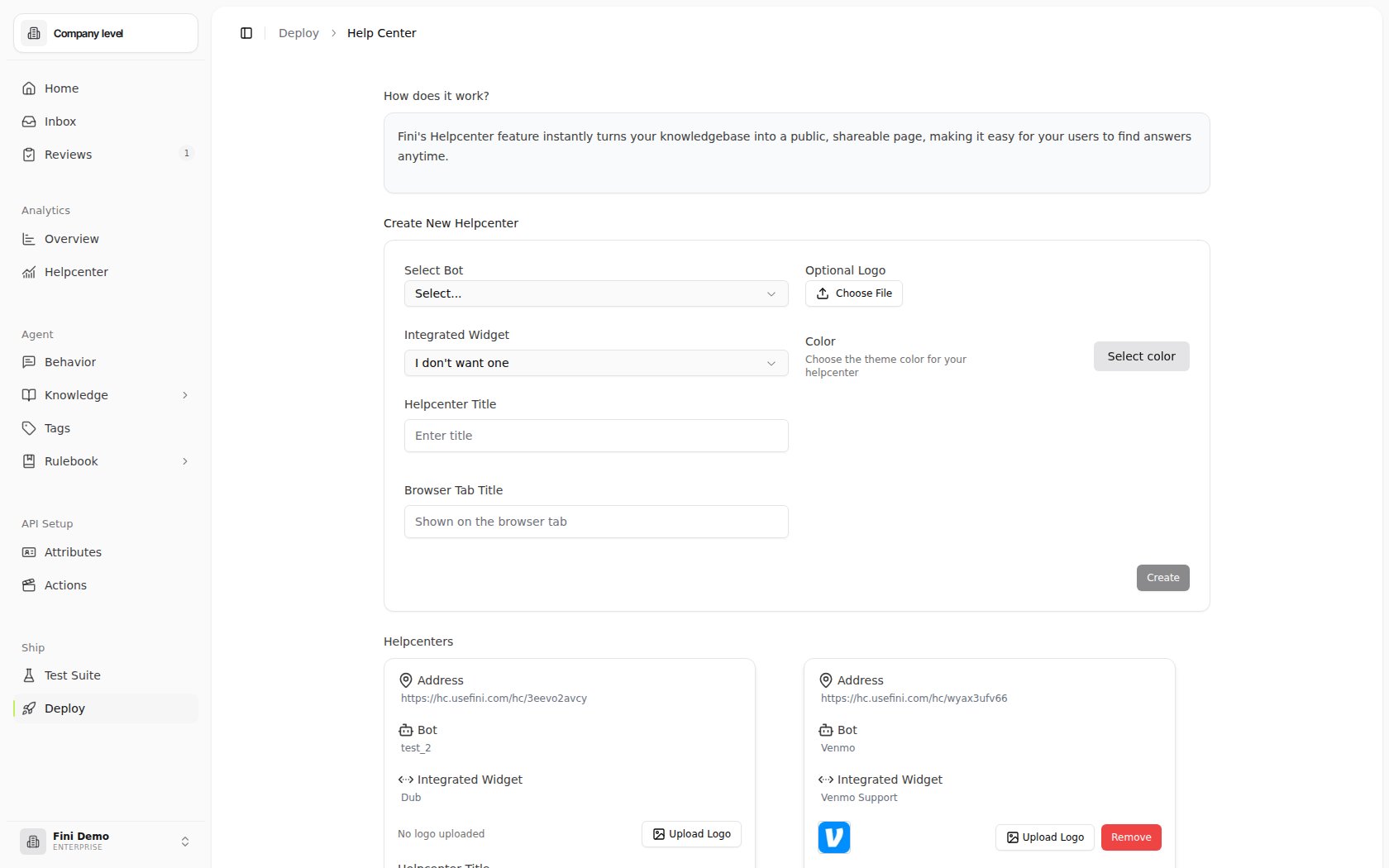
- Address: the hosted public URL.
- Bot: the agent backing the help center.
- Integrated Widget: the widget currently attached, or None.
- Logo / Helpcenter Title / Browser Tab Title / Color: the core editable appearance settings.
- Accent color: the hover and highlight color used in the public page. If you leave it unset, it follows Color.
- Hero title: the large landing-page heading. If you leave it blank, the public page uses “How can we help?”.
- Font: the typeface used on the public help center. The default is Hanken Grotesk; you can also choose Inter, Roboto, Open Sans, Lato, Montserrat, Poppins, Nunito, Source Sans 3, DM Sans, Work Sans, Figtree, Manrope, Newsreader, or Merriweather.
Curate the landing page
The landing page mirrors your published tree, and the curation controls sit on the folders and articles themselves. Go to Knowledge → Articles to set them, rather than the Deploy page. To pin an article near the top of the landing page, open the article and turn on Featured on Help Centre in the status sidebar, next to Public in helpcenter. Feature the high-value answers customers should see first.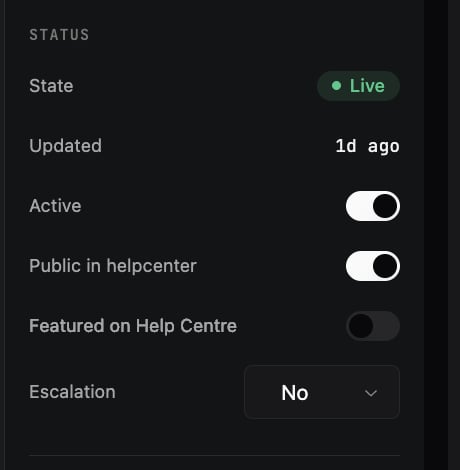
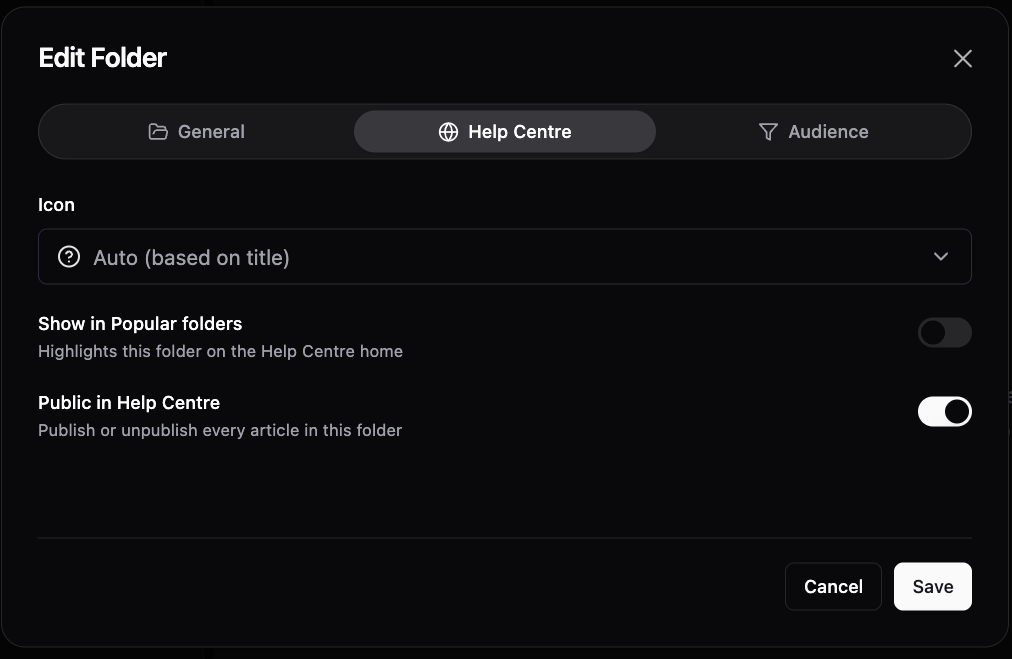
- Show in Popular folders highlights the folder on the help center home. Use it for common product areas and support categories, so customers can browse high-value content faster.
- Icon sets the icon shown on the folder’s category card and navigation entry. It defaults to Auto (based on title), which picks an icon from the folder’s name; choose a specific one to override it.
- Public in Help Centre publishes or unpublishes every article in the folder at once, the folder-level version of the per-article setting in Where the content comes from.
Featured articles and popular folders only appear while the selected item still exists in the selected agent’s public snapshot. If an article is unpublished, deleted, detached from the agent, or no longer marked Public in helpcenter, it drops out of the public page automatically.
Use a custom domain
The Deploy page generates a Fini-hosted URL. To serve the help center from your own subdomain, for examplehelp.yourcompany.com, create the deployment first, then work through the sequence below. The custom domain layers on top of the existing deployment rather than replacing it.
TLS terminates on Fini’s infrastructure. Fini registers your custom hostname, provisions the SSL certificate, and manages its renewal, so you never supply or install a certificate yourself. Your side of the work is one CNAME record, plus one TXT record in the cases where the certificate authority asks for extra proof of ownership.
The sequence alternates between you and Fini:
1. Create a CNAME record
In your DNS provider, add a CNAME record pointing your chosen subdomain to Fini’s proxy:
Replace
help with the subdomain label you want to use.
2. Share your domain with Fini
Send the exact domain you want connected, for examplehelp.yourcompany.com, to the Fini engineering team, and tell us once the CNAME is live. Nothing on our side starts until we have the full hostname.
3. Fini registers the hostname
We register the custom hostname on our infrastructure and start certificate provisioning. In many cases the certificate authority validates ownership from the CNAME alone, and the domain goes live without any further DNS work from you.4. Add a TXT record, only if we send you one
If extra domain ownership verification is required, provisioning generates a unique token and we send you the exact record name and value. Add it to your DNS zone as provided:- Type:
TXT - Name:
_acme-challenge.help(replacehelpwith your subdomain label) - Value: the verification token we send you
- TTL:
Auto
5. Fini confirms the domain is live
Once validation completes, we confirm that the custom domain and the SSL certificate are active. Open the subdomain over HTTPS to check the help center loads under your own branding.Verify it’s working
1
Open the public URL
Open the Address shown on the help center card.
2
Confirm branding
Confirm the page branding matches the title, browser tab title, logo, color, accent color, hero title, and font you configured.
3
Confirm published content
Confirm only the folders and articles marked Public in helpcenter are visible, and that the folder structure matches what you built in Articles.
4
Check the curation
Confirm featured articles are pinned on the landing page, popular folders are highlighted, and folder icons render the way you set them.
5
Test search
Search for a question your agent should answer and verify the result quality.
6
Test the widget
If you attached a widget, open it on the public page and confirm it loads and responds correctly.
Measure and improve
If your workspace has at least one help center, Helpcenter Analytics appears in the main sidebar. Use it to understand how visitors use the public help center before they open the widget or contact support. Help center analytics is separate from conversation analytics. Conversation analytics measures agent conversations, tags, sources, escalation reasons, and resolution; help center analytics measures public-page behavior: visits, searches, article engagement, traffic sources, and content gaps. The page has five tabs:
Alongside the page metrics, Fini records the Was this article helpful? votes from article pages, so you can see which content resolves questions and which needs work. Article tables use those votes to calculate % Helpful. If an article has no votes yet, the helpfulness cell shows
—.
Duration metrics come from public help center pageview and pageleave events. They can show — for fresh deployments or short windows until visitors have opened and left pages in the selected period.
Use the date picker to compare performance across a selected window. The export menu downloads Articles CSV and Searches CSV reports for deeper analysis outside Fini.
Why the help center isn’t working
The help center looks empty
The help center looks empty
Search results are wrong or missing
Search results are wrong or missing
The help center search retrieves from the same articles your agent uses. If results are wrong, the underlying article is wrong, fix it in Articles and the help center updates automatically. If the article doesn’t exist yet, the gap should surface in Review through the AI Knowledge Manager’s continuous detection. You can also check Review directly to see if a draft for this question is already queued.
A featured article or popular folder isn't appearing
A featured article or popular folder isn't appearing
Featured and popular selections only render while the item is in the agent’s public snapshot. Confirm the article or folder is still attached to the agent, marked Public in helpcenter, and live rather than waiting in Review. Items that fall out of the snapshot drop off the landing page automatically.
I picked the wrong agent
I picked the wrong agent
The agent is fixed after creation. Delete the help center and create a new one with the correct agent.
I picked the wrong integrated widget
I picked the wrong integrated widget
The widget association is also fixed after creation. Delete and recreate the help center to change it.
Branding changes aren't visible
Branding changes aren't visible
Make sure you clicked Save on the help center card after editing the title, browser tab title, logo, color, accent color, hero title, or font. If the accent color was reset, it intentionally follows Color again.
The custom domain isn't routing
The custom domain isn't routing
Confirm the CNAME record points to
proxy.finihelpcenter.com, then confirm you’ve sent the exact hostname to the Fini engineering team. Registration and certificate provisioning happen on our side, so nothing resolves until we’ve completed that step.The domain resolves but HTTPS fails
The domain resolves but HTTPS fails
The certificate is still provisioning, or validation is waiting on a TXT record. If we sent you an
_acme-challenge record, confirm it’s present in your DNS zone with the exact name and value we provided, and that no older or self-created version of the record is still in place. Tell us once it’s live and we’ll re-check validation.I can't create another help center for the same agent
I can't create another help center for the same agent
Expected behavior. Fini supports one help center deployment per agent. Edit the existing one, or delete it and create a new one.