

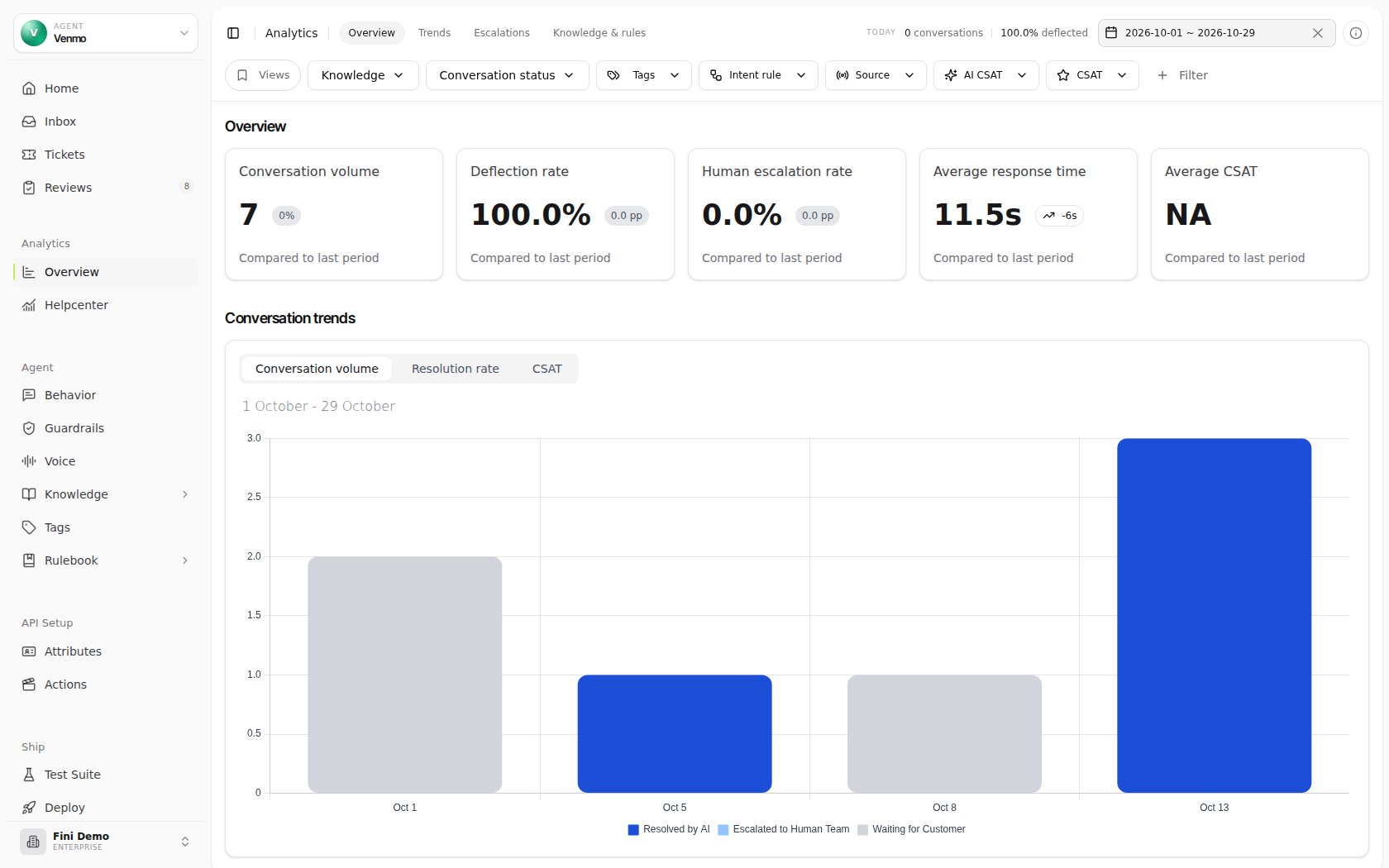
Analytics reads from the same conversations Fini handles live. Every number traces back to real conversations you can open in Inbox, where the full AI Steps trace shows exactly what the agent did. Analytics is the aggregate view; Inbox is the per-conversation view.
Global controls
Most controls at the top of the page filter everything below them. The small Today pulse in the header is the exception: it always shows today’s live conversation count and deflection rate for the selected agent, independent of the selected date range and filters.Agent picker
Top-left, beside the page title. Scopes every chart and table to the selected agent. Multi-agent workspaces use this to isolate a regression to the agent that caused it.Date range
Defaults to the last 7 days. Pick any custom window for spot analysis or longer-term trends. The selected range applies to every KPI card, chart, and table below the header. KPI change pills compare the selected window against the immediately preceding window of the same length.Filters
A row of filter pills sits under the page header. Core filters are pinned by default; optional filters live under the + Filter dropdown. Filters compose, so combining Channel = email and Sentiment = negative isolates angry customers on the email channel specifically. Use Views to save a filter setup you reuse, such as a weekly executive slice, a channel-specific review, or one team’s intent-rule view. Saved views store filters only. Applying one keeps the current date range, so you can reuse the same slice across different reporting windows.KPI cards
Four cards across the top summarize the period. Each shows a value and a colored pill indicating change versus the previous period of the same length. For Deflection rate, Human escalation rate, and Average CSAT, the change pill shows percentage points (pp), not relative percent change. A rate moving from 80% to 85% shows +5.0 pp; an unchanged rate shows 0.0 pp. Conversation volume uses relative percent change, while the response-time card on Performance shows the difference in seconds.
Three statuses, summing to 100%. Every conversation ends in exactly one of three states: Resolved by AI, Escalated to Human Team, or Waiting for Customer. Deflection rate is the complement of Human escalation rate, while AI resolution rate counts only the conversations fully resolved by the agent. The Conversation Status doughnut visualizes the full three-way split.
Trends
Conversation trend charts sit below the KPI cards.Conversation volume, Resolution rate, and CSAT
A toggle at the top of the first chart switches between trend views over the selected range:- Conversation volume, total conversations per day. Use it to spot traffic spikes and drops.
- Resolution rate, the daily resolution rate plotted alongside the Waiting for Customer share. A drop in this trend right after a knowledge or prompt change is a strong signal to roll back or investigate.
- CSAT, daily customer satisfaction trend when CSAT data is available.
Average response time
Open Reports → Performance for the Average AI response time card and Response time over time chart. Both use the average of stored per-conversation average response times, displayed in seconds, not the median. The chart groups those averages by day. Performance has its own date range and filters; check that scope before comparing it with the overview. Use it to investigate latency regressions, including slow Actions.Distribution
The distribution section pairs channel performance with the conversation-status breakdown.
Usage by channels
The channel card combines a conversation-volume doughnut with a table, typically Chat versus Email. Useful for sanity-checking that traffic lands on the channels you expect. A sudden shift from chat-dominant to email-dominant can mean the chat widget broke.Conversation Status
The three conversation statuses, Resolved by AI, Escalated to Human Team, and Waiting for Customer, as proportions of total volume. This is the visual form of the three statuses sum to 100% model from the Note above.Channel breakdown
The channel table sits beside its doughnut and shows Channel, Volume, Resolved, and Deflected. Volume includes each channel’s share of the total. Resolved is the share resolved by AI; Deflected is the share that did not escalate, including conversations still waiting on the customer. Use it to find channel-specific regressions hidden by the overall average.Hourly breakdown
For ranges up to 31 days, Analytics shows volume by hour and resolution rate by hour. Use this to spot staffing or routing gaps: a healthy daily average can still hide a specific hour where resolution falls off.Escalations
When the agent escalates, this section tells you why. Read it when deflection rate is too low: the KPI cards tell you that it’s low, the escalation breakdown tells you what to fix.
Escalation reasons
Every escalated conversation is tagged with a reason from a fixed taxonomy. The reasons group into four families. Knowing which reasons drive escalation tells you exactly where to spend effort.The escalation doughnut
The center count is the total number of conversations in the period, not just the escalated ones. The largest segment, Not escalated, covers everything the agent resolved without escalating. The remaining segments break the escalated conversations down by reason, colored by family. Big non-grey segments are your top fix-it targets.Because the doughnut includes Not escalated, that slice dominates a healthy chart. To read escalation reasons against each other rather than against the resolved baseline, scan the smaller segments and the legend, or apply the Escalation reason filter to drill into one.
CSAT and sentiment
Two feedback signals run alongside each other across the page: what customers explicitly said, and what their words imply.
The two often diverge. A customer might end on a thumbs-up after a frustrating multi-turn exchange (high CSAT, low sentiment), or get a fast answer and never bother rating it (high sentiment, no CSAT). Reading both is more honest than either alone.
Where each signal shows up on the page: CSAT drives the Average CSAT card, the CSAT trend, the CSAT columns in Knowledge performance and Intent rule breakdown, and the CSAT filter. Sentiment is available as a filter under + Filter and informs the per-conversation view in Inbox. When CSAT isn’t configured, the CSAT surfaces read NA and sentiment carries the feedback signal on its own.
Breakdowns
The Knowledge & rules card has Categories, Articles, and Intent rules views. Switch views to inspect folder-level knowledge usage, individual articles, or intent rules. The overview shows up to ten rows per view. Choose View all or Reports → Knowledge & rules for the complete tables; check the report’s date range and filters when you open it. Article rows count conversations that cited each article. One conversation can cite several articles, so article volumes overlap and do not sum to a folder total. The report tables show 25 rows per page, with Previous page and Next page controls when more rows are available. Sorting applies to the full list before pagination. In Categories, pagination counts top-level folders; expanding a folder keeps its subfolders together on that page. These controls are separate from the page-size selector for Matching conversations. Each row shows period-over-period changes for AI resolve rate, escalated rate, CSAT, and volume. Rates use percentage points (pp); volume uses relative percent change. Volume growing from zero displays New rather than an invented percentage. A dash means the comparison is unavailable, not that the metric was unchanged. Missing conversations or ratings can make individual rate comparisons unavailable. Volume changes are neutral; an increase is not automatically an improvement.
Knowledge performance
A table breaking conversations down by knowledge usage. It shows which folders, articles, or source groups the agent used and how each slice performed.
- AI Resolve Rate, share of conversations in that row the agent resolved.
- Escalated Rate, share that escalated to a human.
- CSAT, the CSAT rate for that row, as a color-graded pill. Reads NA when CSAT isn’t configured.
- Volume, total conversations, with a pill showing change versus the previous period.
Intent rule breakdown
A table breaking performance down by Rulebook intent rule, the rules that decide how the agent handles each class of request. Columns:- Intent rule, the rule name as it appears in your Rulebook.
- AI Resolve Rate, share of conversations the rule handled that resolved without escalation.
- Escalated Rate, share that escalated.
- CSAT, satisfaction across rated conversations, with a comparison when ratings are available.
- Volume, total conversations the rule handled.

Matching conversations
In Reports → Knowledge & rules, select a category, article, or intent-rule row to filter Matching conversations below the table. Clear the selection chip to return to the broader report. Choose 10, 25, or 50 conversations per page and use the pagination controls to browse. The list shows Date, Channel, Topic, and Status. Status displays the tag name when available, or a dash when it cannot be resolved. Hover over a truncated status label to read its full name. Open a conversation to read its messages in a modal without leaving the report. Closing the modal preserves the report selection and position. Use the Inbox link for the full conversation, internal notes, AI Steps, and actions; the report modal is read-only and excludes internal notes. The conversation list does not carry every Analytics filter: it carries one CSAT rating only when exactly one is selected, and does not carry the sentiment filter. A selected category or intent rule replaces the corresponding list filter. Do not expect list totals to reconcile with a report using those unsupported combinations, or with summed article volumes.Common workflows
Weekly health check
- Set the date range to the last 7 days.
- Glance at the KPI cards; compare deflection rate to last week.
- Check the Resolution rate trend for sharp drops; correlate with deploys or knowledge changes.
- Skim Knowledge performance and Intent rules for any row that regressed; use the row arrow to open those conversations and spot-check.
Pre-release validation
- Set the date range to the period since you started rolling out a change (for example, the last 24 hours after a prompt edit).
- Compare deflection rate, Average response time, and Average CSAT against the prior period.
- If any worsened, roll back. If all are flat or better, continue rolling out.
Knowledge prioritization
- Open Knowledge performance. Find a knowledge slice with high volume and low AI Resolve Rate.
- Filter by Escalation reason for that slice and see which reasons dominate.
- If Missing Knowledge leads, add Articles or Sources. If Ambiguous or Unclear Input leads, tighten the Rulebook.
- Check the same intent the following week. AI Resolve Rate should rise and the escalation reason should shrink.
Diagnosing a CSAT drop
- Apply the CSAT filter, or sort Knowledge performance and Intent rules by CSAT, to find which slices drove the drop.
- Compare CSAT against sentiment. If both fell together, customers genuinely got worse outcomes, go to the escalation breakdown to see why.
- If CSAT fell but sentiment held, something about how the agent communicated changed, check recent Prompts edits.
- Open the affected conversations in Inbox and read ten of them to find the pattern.
What’s not in Analytics
A few things this page doesn’t surface; you go elsewhere for them:- Per-conversation debugging, that’s Inbox, with the full AI Steps trace per conversation.
- Test pass rates, whether an intent rule passes its regression tests, that’s Test Suite. The Intent rule breakdown above shows live resolve, escalate, and volume per rule; Test Suite shows pass or fail against your test cases.
- Cost and token usage, tracked in workspace settings, not in Analytics.
Related
Inbox
Open individual conversations from any Analytics chart to debug them. Every conversation has a full AI Steps execution trace.
Tags
The tags that drive analytics filters and conversation breakdowns are configured here.
Rulebook
The intent rules measured in the Intent rule breakdown are built and edited here.
Test Suite
Run regression tests before publishing changes that Analytics will eventually measure.